Building one beautiful kiosk is a design project. Building the same kiosk twelve times, on staggered deadlines, across malls and transit hubs with different footprints and different landlords — that's an operations project, and it fails in different ways.
Our fixture program for Fun Peanut, a national Chinese roasted-snack chain that moved a street-stall category into shopping malls, ran across multiple site formats and overnight installation windows. This guide distills what chain operators should have ready before a rollout goes to production.
1. Standardize the kit, not the footprint
No two mall sites give you the same floor plate. Chains that design each location from scratch pay design fees twelve times and get twelve slightly different brands. The alternative is a format system: a defined kit of counter modules, canopy sections, signage elements, and back-of-house units that recombine into your three or four recurring site types.
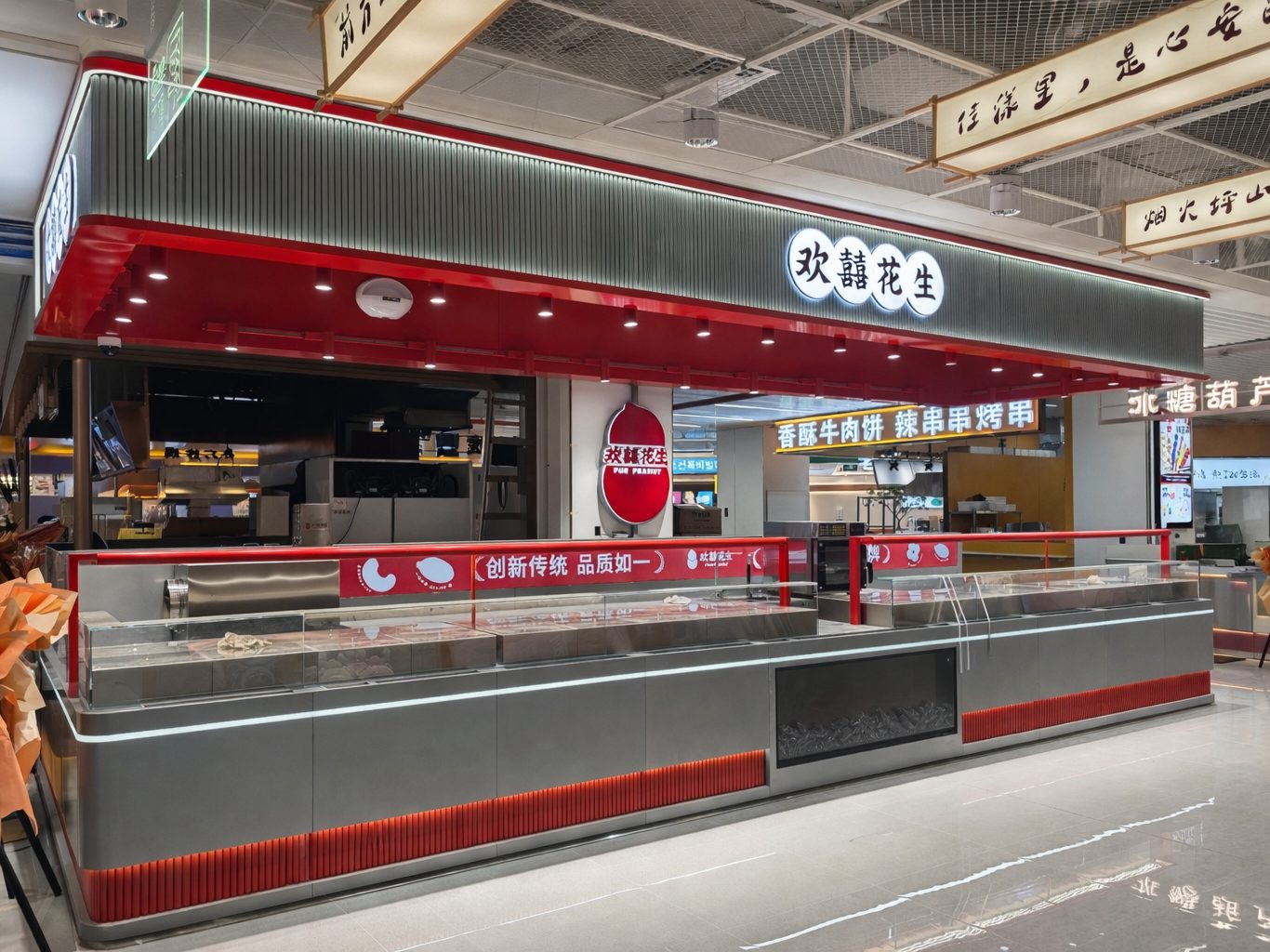
The Fun Peanut program resolved into three formats — island kiosk, corner counter, and inline storefront — all built from shared modules: the same curved-glass display counters, the same red fascia system with arched logo plaques, the same fluted base cladding. A new site becomes a configuration exercise, not a design project, which cuts both lead time and cost per location.
2. Get the food display spec right once
For food retail, the display counter is regulated equipment as much as furniture. Lock these decisions at the program level so every site inherits them:
- Sneeze guards / breath shields: curved tempered glass at the correct height and angle for open bulk displays with sampling
- Serving decks: stainless surfaces, removable trays, and coved corners for daily deep cleaning
- Tiering: stepped bulk trays so product depth looks abundant from the customer side while staying reachable for staff
- Integrated stations: scale, bagging, and POS positions in a fixed layout, so staff trained at one location can work at any location
- Durability: kick plates and edge protection sized for cleaning carts and trolleys — food sites get washed down daily, and fixtures that aren't built for it look tired in six months
3. Design around the overnight install window
Malls and transit hubs rarely give food tenants daytime fit-out access. Your fixture supplier should treat the installation window as a design constraint from day one:
- Factory pre-fitting: every unit assembled, wired, and quality-checked before packing, so site work is positioning and connection, not construction
- Site-labeled packing: crates marked by site and by position within the site, unloaded in installation order
- Pre-wired lighting and signage: halo-lit letters and lightboxes arriving as plug-in assemblies
- Crew-hours budget: a realistic target is a trading-ready kiosk from a single overnight window; anything requiring multiple nights multiplies landlord coordination
On the Fun Peanut program, transit-hub installs were completed overnight with the kiosk trading the next morning — which is only possible when packing lists are written by people who have stood on the install floor at 2 a.m.
4. Batch production and the rollout calendar
Chains rarely open one site at a time. Share your opening calendar with the fixture supplier early, because it changes production strategy: common modules can be batch-produced ahead of site confirmations, with only the site-specific pieces (counter lengths, corner conditions, signage dimensions) built to order. Batching keeps unit costs down and means a newly confirmed site can ship in weeks rather than starting from zero.
Ask suppliers directly: "If I confirm three new sites next month, what's the lead time for site four through six?" The answer tells you whether they've actually run a program or only built one-offs.
5. What to have ready before you brief a supplier
A rollout brief that lets a fixture partner quote accurately contains:
1. Your format types (or the site variety you're seeing, if formats aren't defined yet) 2. Two or three real floor plans representing typical sites 3. Brand fascia and signage standards, including any landlord signage restrictions you've hit 4. Food display requirements — open bulk vs. packaged, sampling, hot/cold holding 5. Your 12-month opening calendar, even as a rough estimate 6. Typical installation window terms from your lease agreements
With those six items, a capable supplier can return a program proposal — module system, unit pricing tiers, and a production/installation playbook — rather than a one-off quote you'll have to renegotiate at every site.
See how this played out across malls and transit hubs in the Fun Peanut Snack Kiosk Rollout case study, browse cafe and food counters, or share your site list with us for a program-level proposal.